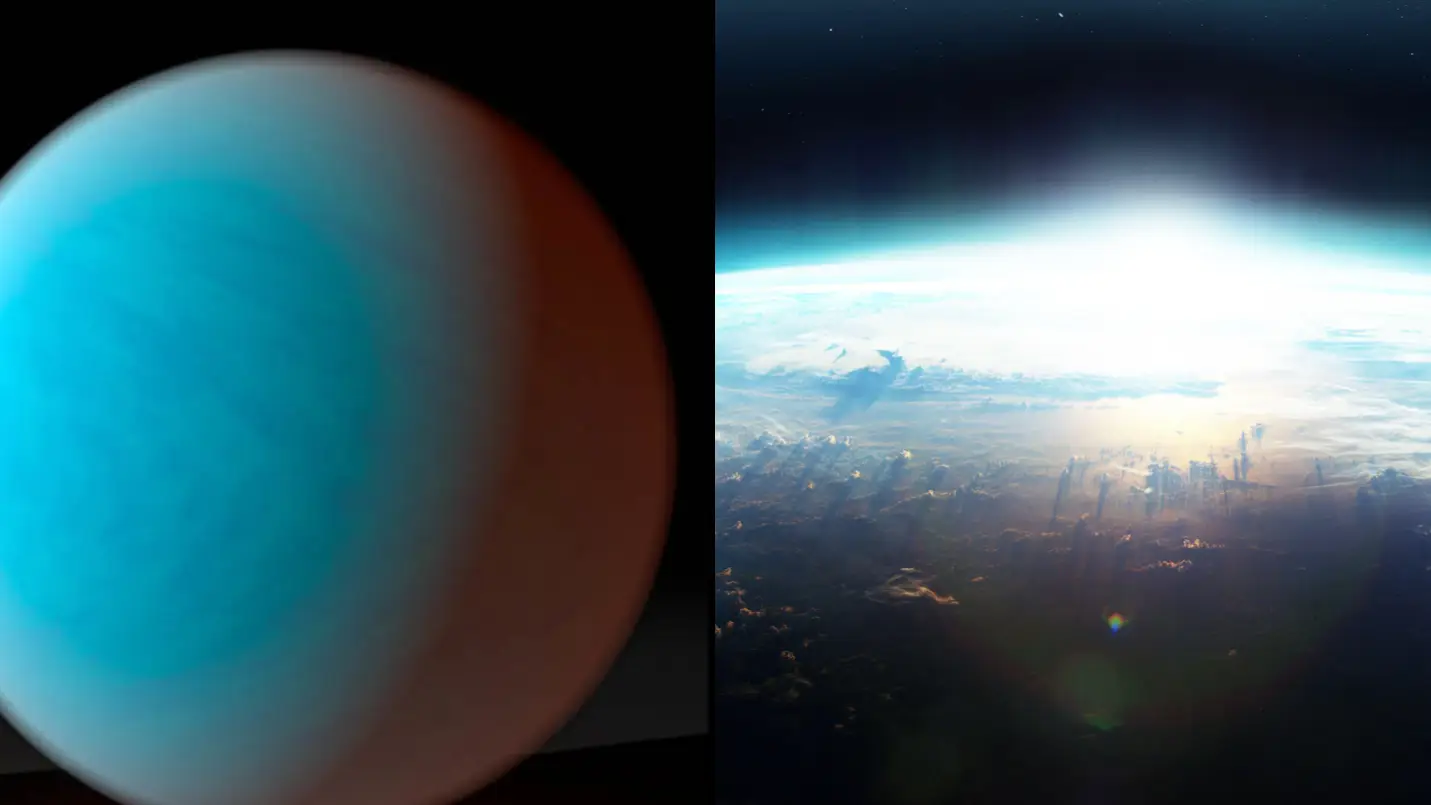
Rare planet found twice the size of Earth that could be entirely covered by an ocean

Scientists have discovered a rare planet that's around twice the size of Earth and covered by oceans.
Snappily named TOI-733b, it's just one of more than 5,000 exoplanets that we know about after the first was discovered in the 1990s.
TOI-733b was found 245 light-years away by NASA's telescope, TESS.
Orbiting a star only slightly smaller than our Sun in a period of just 4.9 days, its relative similarities could prove key to our understanding of planetary formations out there in the universe.
Advert
But what is particularly interesting to researchers about TOI-733b is its size.
There are a surprisingly small number of exoplanets which are between the super-Earth category of exoplanets (up to 1.5 Earth radii) and mini-Neptunes (over two Earth radii).
The reason for the gap, which has been dubbed the 'radius valley', was previously a mystery, but NASA suggests they could be cores of 'Neptune-like worlds'.
Some exoplanets on the bigger side of the radius valley have either lose their atmospheres due to their proximity to stars and become smaller, naked, stripped cores on the lower side of the radius valley - or 'rock planet'.
Or alternatively, it could be caused by an internal process due to heat from the exoplanet's core.
Exoplanets within the radius valley, like TOI-733b, are the key to unlocking the mystery, which is what's got the team of astronomers led by Iskra Georgieva of Chalmers University of Technology in Sweden, so excited about the discovery.
The research has been accepted for publication by Astronomy & Astrophysics, but is also currently available on preprint server arXiv.
Density measurements done on the planet from the vast distance suggest it's either lost an atmosphere it once had or it's a planet that's entirely covered in water.
However, several data points suggest that the atmosphere of TOI-733b is slowly depleting, which could be due to its close proximity to its star's heat.

If the heat of the star it's orbiting is slowly evaporating its atmosphere, then it could possibly transform into a rock planet.
Other theories suggest that TOI-733b has lost its hydrogen and helium, and instead retained an atmosphere filled with water vapour or reformed a secondary atmosphere of heavier elements.
The research says: "Answering the question of whether TOI-733b has a secondary atmosphere or is an ocean planet boils down to differentiating between a Neptune-like planet that lost its ∼10 per cent of H/He to leave behind a steam atmosphere of heavier volatiles, and one that formed and remained relatively the same throughout its evolution.
"While being beyond the scope of this paper, finding an answer to this question will have broad implications on our understanding of exoplanets."
The paper also touched on how exciting and 'interesting' this discovery is in the field of astronomy, holding the potential to prove 'a small but key piece to solving big puzzles in exoplanet science'.
"With ever increasing in-depth theoretical analyses and the promise of high-precision follow up by present and upcoming facilities, we seem to be well on the way to finding answers to major questions relating to planet formation and evolution." it concludes.
Topics: News, Science, Technology, Space
 Amelia Jones