ladbible homepage
ladbible homepage
  • iconNews
  • videos
  • entertainment
  • Home
  • News
    • UK
    • US
    • World
    • Ireland
    • Australia
    • Science
    • Crime
    • Weather
  • Entertainment
    • Celebrity
    • TV
    • Film
    • Music
    • Gaming
    • Netflix
    • Disney
  • Sport
  • Technology
  • Travel
  • Lifestyle
  • Money
  • Originals
    • FFS PRODUCTIONS
    • Say Maaate to a Mate
    • Daily Ladness
    • UOKM8?
    • FreeToBe
    • Citizen Reef
  • Advertise
  • Terms
  • Privacy & Cookies
  • License Our Content
  • About Us & Contact
  • Jobs
  • Latest
  • Archive
  • Topics A-Z
  • Authors
Facebook
Instagram
X
Threads
Snapchat
TikTok
YouTube
Submit Your Content Here
  • SPORTbible
  • Tyla
  • GAMINGbible
  • LADbible Group
  • UNILAD
  • FOODbible
  • UNILAD Tech
NASA's Mars rover makes history after capturing 'Northern Lights' for first time from another planet

Home> News> Science

Published 14:37 16 May 2025 GMT+1

NASA's Mars rover makes history after capturing 'Northern Lights' for first time from another planet

Add Mars to the list of places to go and see the Northern Lights...

Kegan Marquez

Kegan Marquez

google discoverFollow us on Google Discover

People travel from all over the globe to catch a glimpse of the Northern Lights. But it seems you can also get a glimpse of a similar natural display while on Mars.

NASA has made history in space as its Perseverance Mars rover has captured an aurora from the surface of the red planet, the first time this phenomenon has been detected there.

The rover was able to capture a green glow with its SuperCam spectrometer and Mastcam-Z. This emission, which resembles our planet's auroras, had never been confirmed on Mars through visible light until March last year.

The green aurora spotted on Mars came from a 557.7-nanometer emission (light which falls into the electromagnetic spectrum) line linked to atomic oxygen. Scientists expected this to occur in Mars' upper atmosphere but hadn't seen it before.

Advert
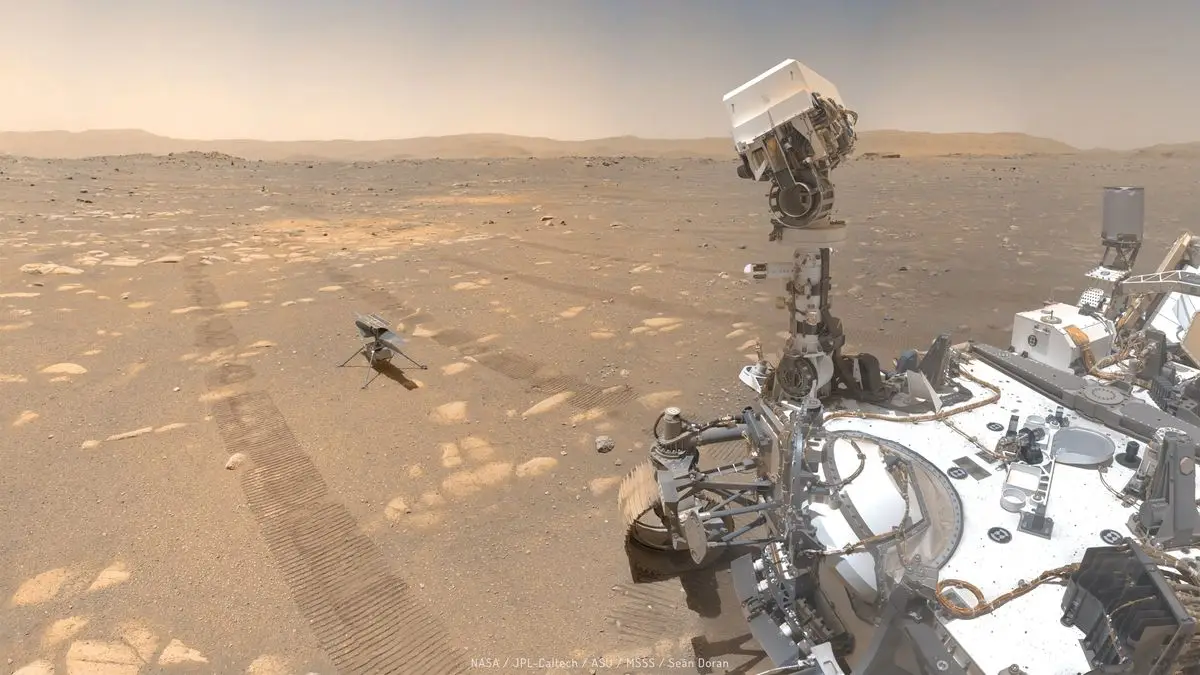
NASA’s Perseverance Mars rover opens up new possibilities for auroral research (NASA/JPL-Caltech/MSSS/Seán Doran)

Earlier auroras on Mars were only detected from orbit and in ultraviolet light.

The discovery - which has recently been published in Science Advances - came after scientists were alerted by a solar event forecast. Researchers from NASA, ESA, and various universities were monitoring an active region on the Sun.

On 15 March, 2024, a C4.9-class solar flare released a coronal mass ejection (bursts of plasma and magnetic field from the Sun) travelling at over 1,100 km/s (683 mi/s).

Three days later, the CME reached Mars, sending energetic particles into the atmosphere and producing auroras on the nightside of the planet.

The aurora was detected at Jezero Crater, where Perseverance is stationed, and the SuperCam recorded the spectral signal at 06:46 UTC.

Mastcam-Z later captured images of a faint green-yellow glow that grew stronger at higher angles.

According to The Watchers, just one emission line was detected during this time, with models indicating that stronger solar storms or clearer atmospheric conditions could result in brighter emissions.
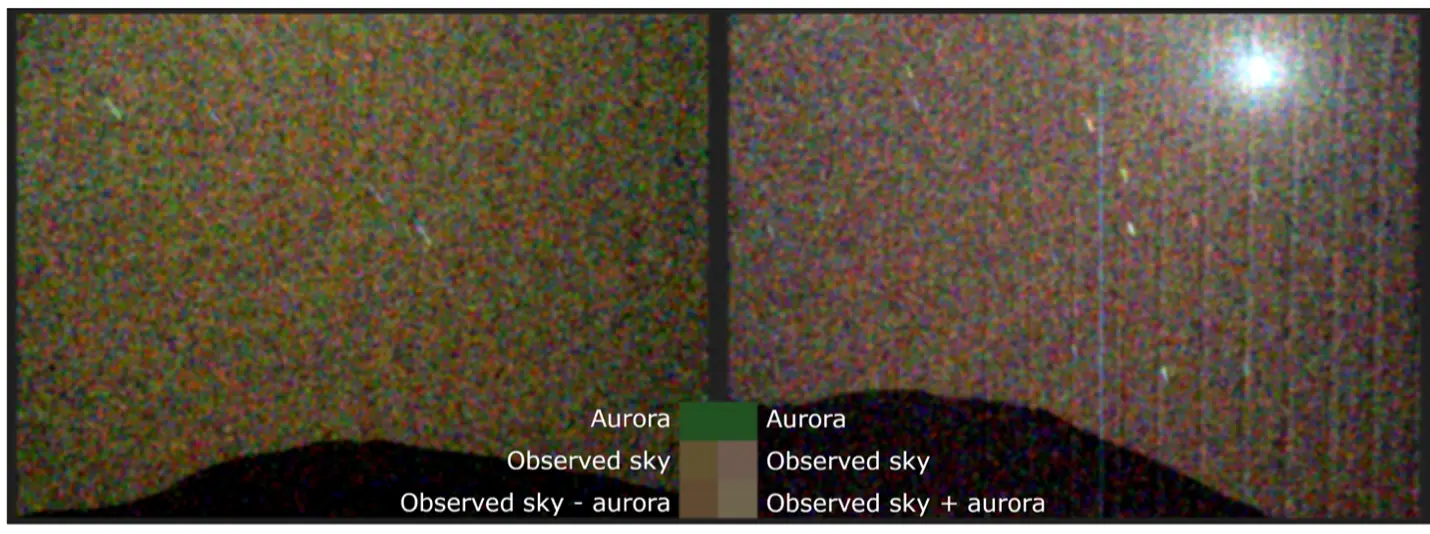
Stronger solar storms could lead to brighter auroras (NASA/JPL-Caltech/ASU/MSSS/SSI)

The researchers reviewed past data and conducted a follow-up observation to confirm that the glow was actually an aurora, as neither showed the same spectral signal.

These findings suggest that visible auroras on Mars might be more common than previously thought, which could, of course, lead to more being recorded on the planet.

This new discovery has opened up the doors to future missions on Mars, to help determine whether special cameras, designed for this purpose, could be used to research further into auroras there.

Elise Knutsen, a postdoctoral researcher at the University of Oslo and lead author of the study, said: "This exciting discovery opens up new possibilities for auroral research and confirms that auroras could be visible to future astronauts on the surface of Mars."

Meanwhile, Katie Stack Morgan, acting project scientist for Perseverance at NASA’s Jet Propulsion Laboratory, added: "Perseverance’s observations of the visible-light aurora confirm a new way to study these phenomena that’s complementary to what we can observe with our Mars orbiters.

"A better understanding of auroras and the conditions around Mars that lead to their formation are especially important as we prepare to send human explorers there safely."

Featured Image Credit: Getty Stock Image

Topics: NASA, Space, Science

Kegan Marquez
Kegan Marquez

Kegan is a freelance writer with a passion for everything tech and gaming. He has worked for global brands across the globe, including IGN, PCgamer, PCmag and many more. When he isn't working, Kegan spends most of his time playing video games, building and upgrading gaming PCs and looking for the next thing in tech to obsess about.

Recommended reads

Baby P’s mum’s fresh bid for freedom months after speaking about toddler’s death for the first time in 18 yearsMet Police/PAWhat astronauts actually eat in space after historic Artemis II launchJim WATSON / AFP via Getty ImagesThe Boys fans have missed massive plot points for final seasonPrime VideoUS Congressman issues bombshell warning over UFO secrets that would leave the world ‘unglued’Heather Diehl/Getty Images

Advert

Choose your content:

6 hours ago
7 hours ago
8 hours ago
  • Met Police/PA
    6 hours ago

    Baby P’s mum’s fresh bid for freedom months after speaking about toddler’s death for the first time in 18 years

    Tracey Connelly told her parole hearing she would be a 'risk to children in her care'

    News
  • Jim WATSON / AFP via Getty Images
    7 hours ago

    What astronauts actually eat in space after historic Artemis II launch

    While space food traditionally used to be limited, technological advances now allow astronauts to eat a wider variety

    News
  • Heather Diehl/Getty Images
    7 hours ago

    US Congressman issues bombshell warning over UFO secrets that would leave the world ‘unglued’

    He claimed he couldn't give details because bad things happened to those who tried to talk

    News
  • Getty Stock Photo
    8 hours ago

    Scientists finally discover location of male G-spot and it's not where previously thought

    The scientists made a very detailed study of the penis

    News
  • NASA Mars Rover captures ‘well-preserved’ honey and waffle structures on red planet
  • NASA's Mars Perseverance Rover begins new search for life in Red Planet's 'crocodile' region
  • New NASA technology makes huge changes to what Mars rover is capable of
  • Northern Lights could be visible tonight as alert issued