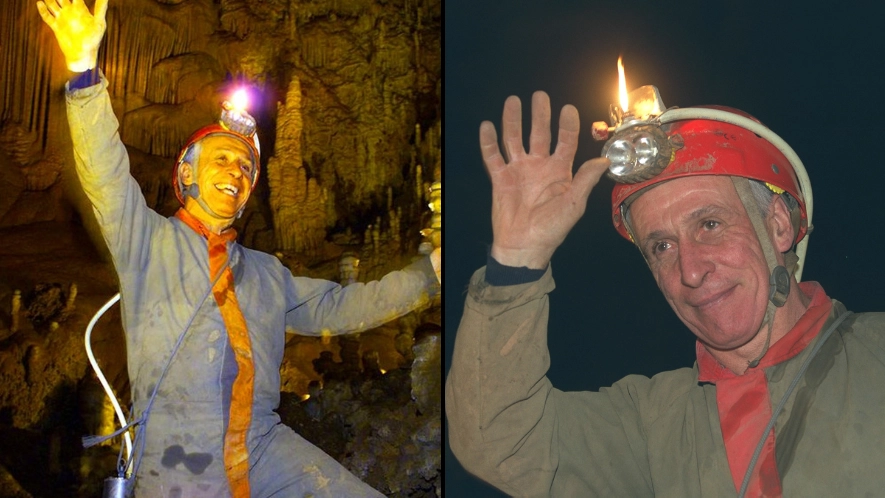
Man who lived in cave with no concept of time ended up experiencing unbelievable effect on his body clock

One man’s experiment on his own life would become so notorious that even NASA wanted to take a look at his findings.
Michel Siffre, who died at 85 this year, conducted a groundbreaking investigation into how people experience time, but he did it in the craziest way.
Now, if you don’t like the dark, damp, cold or lack of social life, then this isn’t for you.
However, by cutting himself off from the entire world for two months in 1962, Siffre was able to find out some incredible things about the human mind and body.
Advert
Inspired by the space race, the French scientist decided to really test himself to the full limits by removing time from the equation.
This means that he removed his wrist watch and confined himself 130 metres below the surface in the Scarasson mountain, which is located in the Ligurian Alps.
Even though it happened over six decades ago, it made positive movements in science.

Why did Michel Siffre do it?
Armed with only a torch, the then-23-year-old set up camp as best he could next to a glacier in a bid to find out how the absence of external cues reminding us it's night and day could affect biological rhythms.
With a particular interest in how the lack of light would impact him, Siffre slept and ate only when his body told him to rather than keeping to the rigid timings the rest of the world follow because society says so.
He lived below the surface completely alone for a whopping 63 days in the name of science - and he emerged, albeit with severe sensitivity to daylight, victorious.
That's because when Siffre became something of a cave dweller, he made a series of incredible findings regarding how humans respond to living with zero information about time - with no clocks, calendars or sunshine to remind him.
He discovered that our bodies have their own clocks, which is now known as chronobiology.
What living without time was like?
Speaking of his landmark expedition, Siffre told Cabinet Magazine in 2008: "This idea came to me—this idea that became the idea of my life. I decided to live like an animal, without a watch, in the dark, without knowing the time.
"Instead of studying caves, you ended up studying time. Yes, I invented a simple scientific protocol.
"I put a team at the entrance of the cave. I decided I would call them when I woke up, when I ate, and just before I went to sleep. My team didn’t have the right to call me, so that I wouldn’t have any idea what time it was on the outside.
"Without knowing it, I had created the field of human chronobiology."
Despite having 'bad equipment', only a 'small camp' to live in, dealing with below freezing temperatures and extremely high humidity, Siffre managed to keep his head in the game - or so he thought.
The scientist says he passed the time over the two months by 'reading, writing and doing research' in the cave, while also daydreaming about his future often.

The effects of living in a cave
He explained that he kept tabs on himself by conducting two tests each time he called to his team on the surface, which were taking his pulse and carrying out his own 'psychological test'.
Siffre explained: "I had to count from 1 to 120, at the rate of one digit per second. With that test we made a great discovery: it took me five minutes to count to 120. In other words, I psychologically experienced five real minutes as though they were two."
Although you may think this is probably an easy mistake to make while living in a cave for two months, it was in fact an extraordinary discovery about the effect of living without time prompts.
Siffre was essentially experiencing everything twice as slow as they actually were - so if all you people who wish 'time would slow down' really want to experience it, it sounds like you just need to move into a cave for a couple of months.
The Frenchman only came to this stark realisation when his colleagues informed him that the day had finally arrived for him to finish the experiment - which came as quite a shock, as he believed he had an entire month left of it.
"My psychological time had compressed by a factor of two," Siffre said.
Siffre's theories
He explained that he had been investigating the disconnect between psychological time and an actual clock for forty years and had came up with his own theory about the reason why this happened to him.
Siffre continued: "I believe that when you are surrounded by night—the cave was completely dark, with just a light bulb—your memory does not capture the time.
"You forget. After one or two days, you don’t remember what you have done a day or two before. The only things that change are when you wake up and when you go to bed. Besides that, it’s entirely black. It’s like one long day."
But even after all that, the 63-day streak holed up inside a cave wasn't enough for Siffre and he decided to head back into the darkness a decade later, but this time, he'd be having a six-month stay in a cave in Texas.
After organising dozens of other underground time isolation experiments in the ten years in between, the Nice-born adventurer decided to isolate himself for half of a year to see what happened to his internal clock.
He again made another incredible discovery, as he found that without time cues, people adjusted to a 48-hour cycle rather than the 24-hour one we're all used to.
NASA used the findings from Siffre's experiments to help astronauts who had reported experiencing similar short-term memory problems after being isolated from external time references.
Like I said - he's a bit of a legend in the scientific world.
 Britt Jones